Data Breach! Protect Your Maine Business With Cyber Liability Insurance


Every week we hear news of another household brand name suffering a data breach. Hannaford, Target, TJ Maxx, Shaw’s, Home Depot…the list goes on.

But local businesses are not immune from hacking. Many Maine small businesses – and their customers – were shocked recently to hear about a breach at two Portland, Maine locations of Otto Pizza, a local favorite.

Otto Pizza responded to the breach candidly, and with personal comments that struck at the heart of any local business owner:

Quote from Otto Pizza about theft of their customers' data

Cyber attacks are a constant threat to your Maine office, retail store or professional practice. You no longer have to be a “big fish” to be a target. Hackers, phishers and the like are always looking for low-hanging fruit in the form of networks with poor security. After beefing up your security, you should insure your Maine business against data breach in case it does happen.

How Do Data Breaches Happen?

Some common scenarios that can lead to data breach in your business or professional practice:

  • Unauthorized access – hackers gain access to your POS system or computer network.
  • Theft of Computers – Someone steals your laptop, backup data or server that holds customer or employee personal information.
  • Improper Disposal of client or patient records.
  • Human Error – your bookkeeper mixes up 1099 forms and mails them in the wrong envelopes, exposing personal information to others.


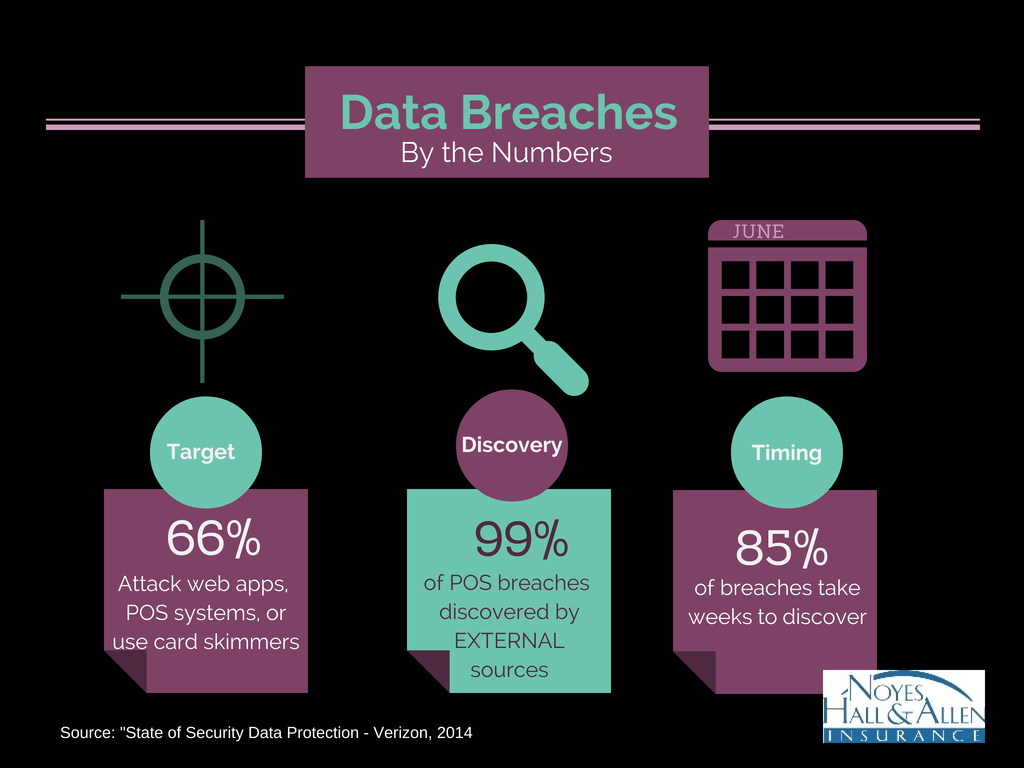
Sobering Data Breach Statistics


infographic: Statistics about business data breaches


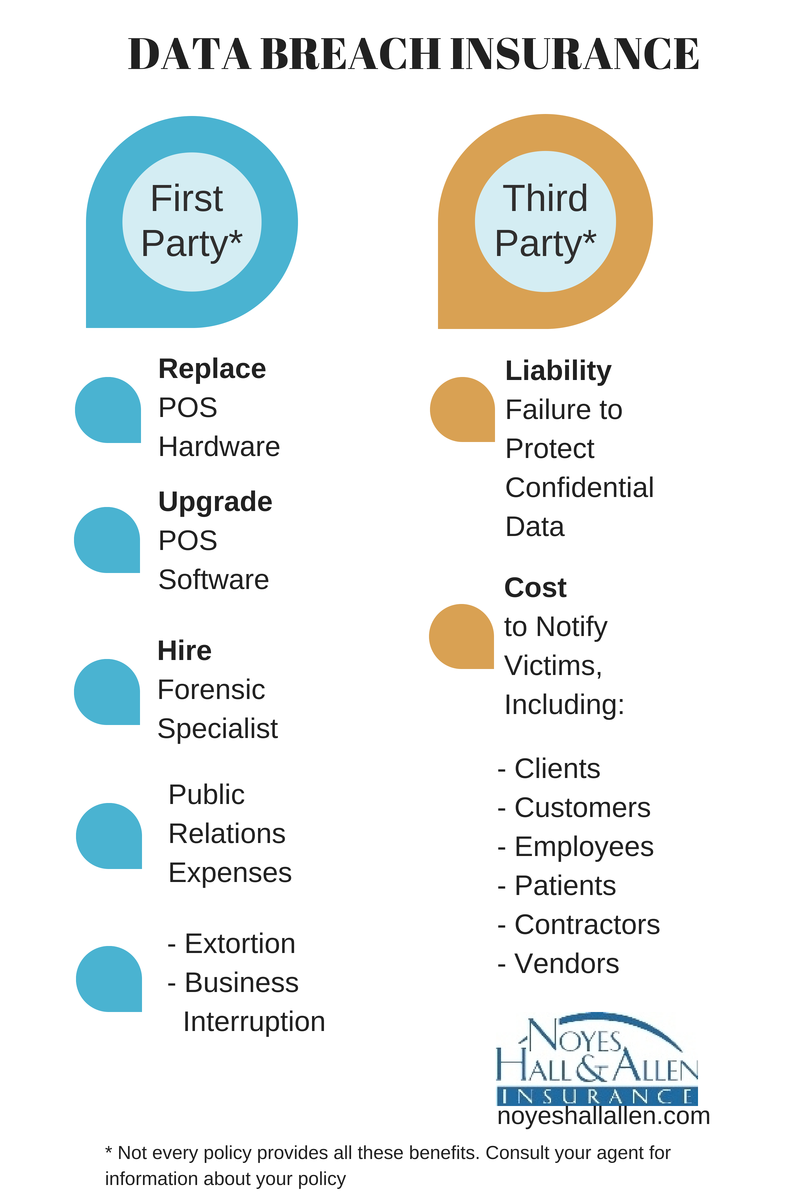
 What Does Data Breach Cyber Liability Insurance Pay For?

What does Cyber Liability Insurance pay for?

Cost of Maine Cyber Liability Insurance

Data breach protection is a surprisingly affordable addition to most Maine small business insurance portfolios. Coverage for basic limits such as $10,000 first party and $25,000 third party are available for premiums as low as $150 per year.

What to Do in Case of a Data Breach at Your Business

  1. Notify the police immediately
  2. Report the breach to your business insurance agent or company
  3. Take all steps to protect any confidential data remaining in your control.
  4. Preserve all evidence of the breach itself.

For answers to your Maine business insurance questions, including data breach and cyber liability insurance, contact a Noyes Hall & Allen agent in South Portland at 207-799-5541. We represent many insurance companies so we can help you find the best insurance fit for your business and budget. We’re independent and committed to you.

FMI:

Payment Card Security Standards

CyberRisk 2014 White Paper by Insurance Information Institute

Does Your Home Insurance Cover Short Term Rental?

From Portland to Cape Elizabeth, Pine Point to Sebago Lake, peer-to-peer rental services are very popular in Maine. Recent articles in the Portland Phoenix and Portland Press Herald suggest that the practice is increasing. Does renting your Portland Maine area home, apartment or condo via a short term rental service like AirBNB, HomeAway or VRBO affect your insurance? You bet!

rentme

You’ll Have Almost No Coverage for Your Stuff – Ever!

If you regularly rent your home or part of it, most Maine homeowners insurance policies limit coverage for your personal property (stuff) to $2,500 per unit. If your place burns down, or is damaged by a storm, you’ll have very little insurance coverage to replace  your belongings, furnishings, appliances, clothing, sporting goods or tools.

Even worse news: your home doesn’t have to be rented at the time. It only has to be “regularly rented or held for rental”. Does listing your home on a website with a calendar of availability make it “regularly held for rental”? The insurance company might say so.

You May Have No Liability Protection Either

Do you rent your entire home more than “occasionally”? If so, you have no liability coverage on your homeowners policy. What’s occasionally, you ask? The policy doesn’t define that. Nervous yet?

Do you rent part of your home or condo to someone who brings more than 2 others? Homeowners insurance policies exclude liability coverage completely. If your tenant or their guest gets hurt, who do you think they’ll expect to pay their medical bills, lost wages and pain & suffering? Even if you aren’t at fault, you might have to hire a lawyer to defend you.

Does the Peer-to-Peer Network Protect You?

We haven’t seen any insurance agreement that covers you where your homeowners, renters or condo policy does not. We have seen one that completely replaces a homeowners policy with a commercial insurance policy, at a higher cost. If you rely on protection from the peer-to-peer site, we recommend that you read their insurance contract very, very carefully.

Can Your Insurance Company Cancel Your Homeowners Policy if You Rent Your Property?

Many insurance companies believe that their ordinary homeowner’s insurance rates are insufficient to pay losses resulting from renting your home. They may ask you to stop renting or to make changes in your home. If you fail to comply, they may cancel your policy. That may tempt you to not tell your insurer about your rental income, and hope for the best. That’s taking a big risk.

We recommend that you talk to your Portland area insurance agent before you rent your home. They can discuss options for properly insuring you against catastrophic loss. It may cost a bit more, but at least you’ll know you have coverage.

For more information about Portland Maine homeowners, condo or renters insurance, contact Noyes Hall & Allen at 207-799-5541.

Party Time! Does Maine Homeowners Insurance Cover Renting a Hall?


It’s party season in Maine. Many of our clients will host a Bar Mitzvah, wedding, baby shower, reception, anniversary party, memorial service, graduation party, or fund raiser. They’ll rent a church hall, function hall, camp, country club, college or city building. And, they’ll call us for insurance advice.

The Good News: You’re Covered!

If you bought  homeowners, condo or renters insurance from Noyes Hall & Allen, your policy says:

6. “Insured location” means:
h. Any part of a premises occasionally rented to
an “insured” for other than “business” use.

Those terms in quotations are defined in your insurance policy. If your policy has your name on it, you’re an “insured”. If you’re not profiting from the function, it’s not a “business”.

Boom! Your Noyes Hall & Allen homeowners policy covers your liability from the function and the hall rental.

The Function Hall Should NOT Want to Be an Additional Insured

Every venue should have a rental contract. Most  contain “hold harmless” clauses. That means you agree to be responsible for what happens while you’re renting the premises. Scary? Maybe, but unless you want to have everyone at your house, you don’t have much choice.

Some venues ask to be an “additional insured” on your homeowners insurance policy. Additional insureds are common on Maine business insurance policies. That makes sense, since businesses operate various activities in many locations. It’s not the same on a personal policy.

That Word

The Additional Insured form on a homeowners insurance policy (HO 04 41) is different. It limits “insured” status to others to your home. In other words, it’s useless in a case where you’re renting a function room. No homeowners insurer that we are aware of allows “additional insured” status for cases like this.

Also, remember the “business” exclusion on the homeowners policy? That applies to all “insureds”. So your homeowners policy excludes the owner of the function hall from coverage as an insured anyway.

A function hall shouldn’t ask you to list them as an “additional insured”. Tell them we said so.

Let’s Keep it Simple

Your Maine homeowners insurance is a broad and powerful tool. It protects and defends you against injury and damage you’re liable for. That includes liability you assume by a contract.

You signed a rental contract for the hall. You agreed to hold the owners harmless for what happens during your function. If someone sues the owners for an accident at your function, they will turn that lawsuit over to the responsible one: you. And, your homeowners insurance will protect and defend you.

This is all INCLUDED in the homeowners, renters or condominium insurance policy you already have. You should only need to prove to the hall that you have insurance. Call us, and we can do that for you.

What About Liquor Liability?

Homeowners policies cover you for what happens on the premises. They exclude liability from auto accidents. Look to an auto insurance policy first for that coverage. The driver’s auto insurance would protect you AND them. If the driver doesn’t have enough insurance, your own Maine auto insurance should also protect and defend you. The coverage and damages can vary greatly depending upon individual circumstances. Talk to your Maine insurance agent for individual advice.

Pro Tip: Hire a professional bartender. They’re trained to recognize when someone has reached their limit. Ask them for a certificate of liability insurance. Mingle with your guests and enjoy your party, instead of stressing out!

Do I Need Wedding Insurance?

Wedding insurance is a different product. It covers the additional costs created if your venue closes, your photographer or band cancels, or some other calamity happens. That’s different that the liability issue we’ve been discussing.

If you live in the Portland Maine area and have questions about renting a hall, wedding insurance, or other insurance questions, contact a Noyes Hall & Allen Insurance agent at 207-799-5541. Noyes Hall & Allen represents many of Maine’s preferred insurance companies, and offers choice and professional advice. We’re independent and committed to you.

Insuring a Maine Condo Rented to Others


Do you need to insure a condominium in Maine that you rent out as income property? Insuring condos can be complicated. Your condo association has a master insurance policy. You have a unit owners insurance policy. Your tenant should have renters insurance. Which policy pays if your unit suffers water damage, fire, or other covered loss?

What’s Insured by the Condo Association Master Policy?

The master policy will cover building portions as prescribed by the bylaws that govern the association. Some associations insure the entire building complex (known as “all in” in insurance jargon). Others require a unit owner to insure the interior of their unit, everything inside the studs. Still others only require the unit owner to insure improvements and betterments made to the condo after it was built. Check your association bylaws and insurance policy to see which applies to you.

What’s Insured by Your Unit Owners Policy?

Your policy will cover items not covered by the association’s master policy. This might include improvements to the unit or the association deductible. Condo bylaws can vary greatly. It’s important to consult a Maine insurance agent who knows how to insure condominiums. They should understand your bylaws and your association’s insurance policy to help you buy proper coverage.

Many insurers issue condominium unit owners policies for rented condos. Others may use a Dwelling Fire insurance form, with customizing endorsements. As long as they are tailored to your situation, either should provide acceptable coverage.

Make sure that the owner of your condo unit is listed on your policy. If you set up a trust, LLC or other entity, if they’re not listed, they’re not covered. This is especially important in case of a liability claim involving your condo unit.

What’s Insured by Your Tenant’s Renters Insurance?

Your tenant’s renters insurance policy covers their “stuff”, such as furniture, clothing, and computers. Your policy will NOT pay for this damage. Neither will the association policy. Save yourself from conflict; require your tenants to buy renter’s insurance.

Questions About Condominium Insurance?

Insuring a Maine condominium can be complicated. Noyes Hall & Allen Insurance serves dozens of Southern Maine condominium associations from two-unit conversions to 100+ unit complexes. If you have questions about condo insurance, contact a Noyes Hall & Allen Insurance agent at 207-799-5541

Related Posts

Should a Portland Maine Landlord Require Renters Insurance?

Renting Your Home? Get Landord Insurance.

Attention Renters: $0.50 a Day Makes All the Difference

Should a Portland, Maine Landlord Require Renters Insurance?


Many Portland, Maine landlords make their tenants purchase renters insurance when leasing an apartment or condo. This is a smart idea for both parties, for many reasons.

Why Should a Landlord Require Renters Insurance?

Protects the Landlord’s Assets

Renters insurance (HO-4 in insurance jargon) is the best way to protect a property owner’s assets from the risks of their tenants’ activities. It protects the landlord in 2 important ways:

  • Insulates the landlord from tenants’ liability. If your tenant leaves something on the stairway that causes someone to fall and get hurt, it’s the tenant’s fault. A tenant without insurance makes you an easier target for a lawsuit, because you have more assets (and insurance). Renters insurance insulates you because it pays your tenant’s legal defense costs and damages.
  • Covers Tenants’ Belongings. Many renters ask “does my landlord’s insurance cover my stuff?” They’re shocked to learn that it does not. They think that if there’s a fire, theft or leaky pipe, their landlord’s insurance will pay to replace their stuff. It won’t. Smart property owners make tenants buy renters insurance to avoid these disputes and disappointments.

It’s Another Way to Screen Tenants

Most responsible Portland Maine landlords run credit checks on prospective tenants, and check their references. This protects them and other building tenants from the harm and nuisance of undesirable renters. Requiring renters insurance is another way to screen out bad tenants.

If a prospective tenant balks at buying insurance to protect their own assets, how will they treat YOUR property? If they say they can’t afford $10-15 per month for insurance, perhaps they’re not going to pay their rent on time, either.

Should a Landlord be an Additional Insured on a Tenant’s Renters Policy?

NO!

Some Maine landlords or property managers ask tenants to add them as an Additional Insured on their renters insurance policy. They believe that it provides more insurance to them and notifies them if the tenant cancels their insurance. Don’t do it!

Why an apartment or condo landlord should NOT be an Additional Insured on their tenant’s policy.

  1. Most insurance companies won’t do it. Listing landlords  as “additional insured” is common on commercial insurance policies. But personal insurance companies frown upon it. Commercial insurers also readily provide a “certificate of liability insurance” to landlords. Personal insurance underwriters usually refuse.
    Personal insurance companies use the Additional Insured endorsement when the “named insured”  and another party are related (e.g. co-owners). An insurer defends and pays for an  Additional Insured’s liability  from “ownership, maintenance or use of the residence premises”.  They would accept this scope of responsibility for co-owners of a property, but not landlords.
  2. It’s unnecessary if you have a lease. Tenants policies extend liability coverage for duties a tenant assumes via contract before the occurrence. If the lease contains a “hold harmless” clause in which the tenant waives rights of subrogation against the landlord, the tenant’s policy will pay, and the tenant’s insurer will not attempt recovery from the landlord.
  3. There’s a better way to notify you if your tenant’s policy cancels. It’s called Additional INTEREST Endorsement. This meets the needs of landlords, and maintains the integrity of  landlord/tenant responsibilities.

Recap

Portland Maine landlords, property managers, and property owners who rent apartments or condominiums to others should require tenants to purchase renters insurance, and ask to be named as an additional interest (NOT additional insured).

If you rent a home, apartment or condo to others, or own other residential rental property, and have questions about Portland, Maine business property insurance, contact a Noyes Hall & Allen Insurance agent at 207-799-5541. If you need renters insurance, contact us for a Portland Maine renters insurance quote.

How to Choose Uninsured / Underinsured Motorist Limits in Maine

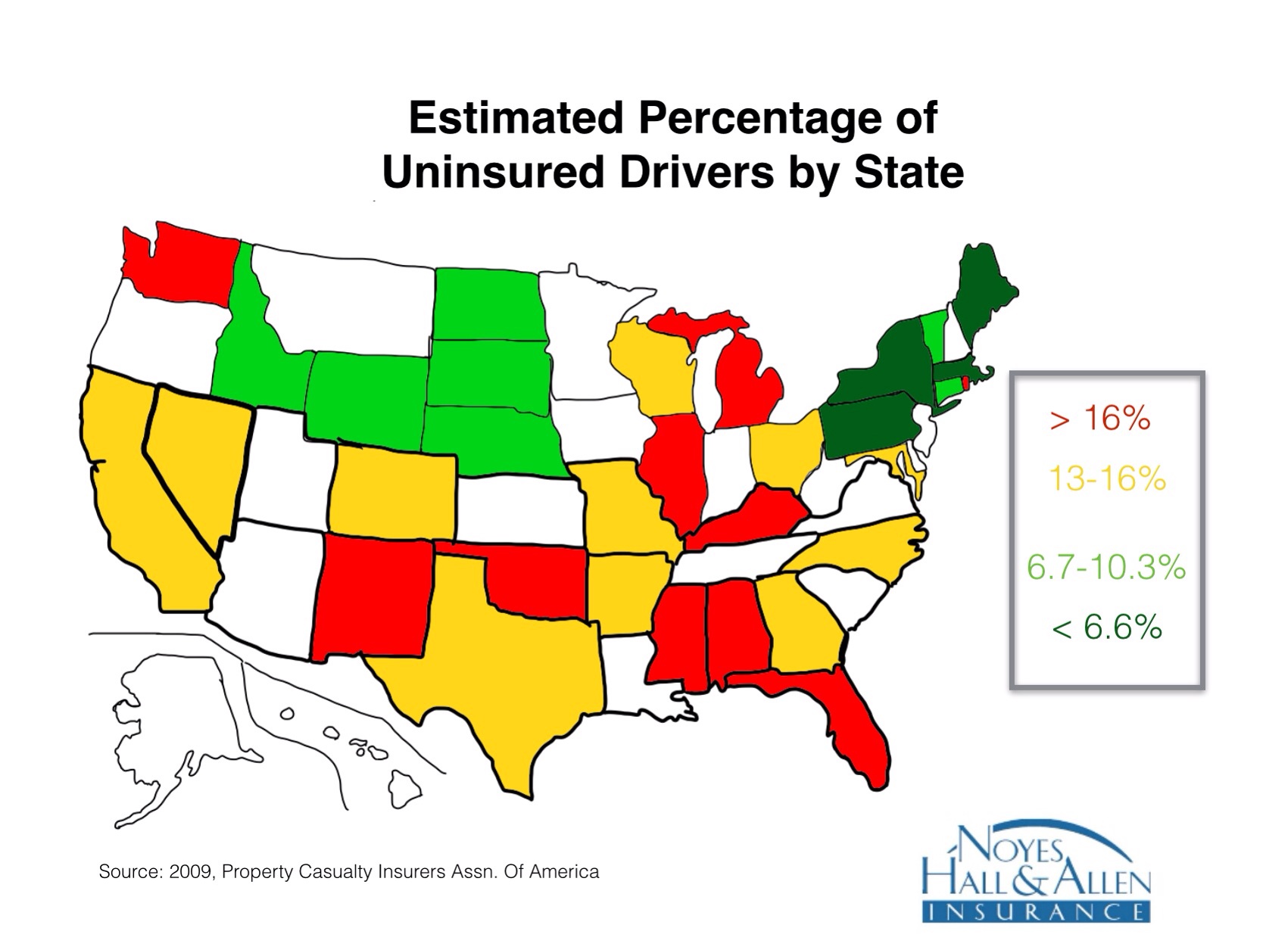
Uninsured_drivers_by_state
Click to enlarge

Almost every state in the U.S. requires drivers to have car insurance. Like every other law, there are always some people who choose to ignore or disobey it.

The good news: if you are in a crash in Maine, the other driver probably has insurance. Maine is in the Top 10 states for percentage of insured drivers.

The bad news: many Maine drivers carry very low liability limits – as low as $50,000 per person. After an accident, your medical expenses can easily exceed that.

What if the Other Driver Doesn’t Have Enough Insurance to Pay My Damages?

It’s great if the at-fault driver has insurance. Do they have enough insurance to pay your damages? Who knows? At 50/100/25, Maine’s minimum auto liability insurance limits are among the highest in the country. But if you drive a late-model car, $25,000 isn’t going to replace it. If you are badly injured, you can accumulate $50,000 in medical bills in one day. You need to protect yourself.

What Happens if Someone Hits Me and They Don’t Have Insurance?

If an uninsured driver hits you, you have to rely on your own Maine auto insurance. Your collision coverage (if you purchased that option) will pay to repair your vehicle. If you don’t carry collision insurance, you’ll have to deal with the damages on your own. Some other states offer “uninsured motorist physical damage” coverage. Maine does not.

What is Uninsured Motorist Coverage (UM)?

In Maine, Uninsured Motorist coverage is bodily injury coverage only. It protects you and the people in your vehicle by acting as if the person who hit you had the same liability limits you have. UM limits always match your policy’s liability limits. That’s another reason we say don’t cheap out when you choose your liability insurance limit.

Let’s say you’re driving in Portland, Maine. You have Uninsured Motorist coverage with Maine state minimum liability limits of $50/$100. Someone runs a red light and broadsides you. Your daughter goes to the hospital with broken bones and internal injuries. You were not injured as badly. After an ambulance ride, the hospital releases you with minor injuries. Your daughter’s medical expenses are $75,000, and yours are $2,500. In this scenario, you would have to pay $25,000 of your daughter’s medical bills ($75,000 – $50,000) out of pocket. If you had chosen a $300,000 combined single limit, all medical expenses would have been covered 100%.

What is Underinsured Motorist Coverage (UIM)?

Underinsured motorist coverage applies when someone has insurance, but not enough to pay for your injuries. Like Uninsured Motorist coverage, it pretends that the person who hit you had the same limits as you do.

Let’s assume the same accident scenario as above, except the at-fault driver did have insurance with Maine minimum limits of $50/$100. Their insurance wouldn’t be sufficient to pay for your daughter’s medical bills.

If you also had $50/$100 limits, you would still be out of luck. You didn’t buy any more insurance than the person who hit you did. But, if you had chosen a $300,000 limit, your UIM coverage would pay up to $250,000 per person, the difference between your insurance limit and theirs.

Danger: Uninsured Drivers in Vacationland

Although most Maine drivers are insured, remember that tourism is Maine’s largest industry. Visitors from other states are constantly driving among us. They’re in unfamiliar territory, and distracted by Maine’s natural beauty. They’re trying to follow GPS directions. Perfect scenario for an accident, right? Depending on the state they’re from, there’s almost a 25% chance that they have no insurance. So, pay attention to your Uninsured / Underinsured Motorist coverage limit.

What Liability and Uninsured / Underinsured Motorist Limit Should You Choose?

Everyone’s situation is unique. We recommend discussing your situation with a Trusted Choice Independent Insurance Agent. If you live in Greater Portland, contact a Noyes Hall & Allen agent at 207-799-5541 for a custom review of your insurance and your options. We represent most of Maine’s preferred insurance companies, and can help you choose the one that best meets your needs.

Should I Cancel My Maine Auto Insurance When I Sell or Won’t be Driving My Car?


It seems simple: why would I have auto insurance if I don’t own a car? Or if I’m storing it for a long time? That’s a waste of money! Believe it or not, it may make sense to maintain your auto insurance, depending upon your future plans.

Of course most of us know better than to cancel our auto insurance when we own a vehicle. It’s illegal to drive without insurance in Maine, and foolishly risky everywhere. But there are cases when responsible people consider letting their Maine auto insurance lapse.

You’re Not Going to Use Your Car for a Long Time

You’re going on a long trip, sabbatical, or a semester abroad. Your car will be parked while you’re away. It’s tempting to save money by canceling your auto insurance, and start it up again when you return. Here are some things to keep in mind.

  • Someone may need to borrow your car.
  • You may want someone to drive it occasionally to keep it lubricated, rotate the tires, and prevent animals from nesting in it (it happens).
  • Things can still happen to a parked car. Trees fall, garages collapse, cars get stolen, vandalized, or damaged by people parking next to it.

 You’re Selling Your Only Vehicle

Our Portland Maine area insurance agency recommends that you at least consider a “named non-owner” policy – especially if you’re likely to be  without a car for less than a year. Here’s why:

1)      You Might Drive Someone Else’s Car. In the U.S., you’re borrowing someone’s insurance when you borrow their car. But do they have any? If so, how much? Without a named non-owner policy, you would be personally liable if they don’t have insurance, or don’t have enough to pay for the damage you cause.

2)      You Could be Hurt as a Passenger, Pedestrian or Cyclist. Your auto insurance provides medical payments coverage in case you are hurt in a car accident. This applies whether you’re a pedestrian, passenger or cyclist. A $5,000 limit would probably be enough to cover your medical insurance deductible.

3)      You might rent a car. A Maine named non-owner policy would provide liability coverage for vehicles rented in the U.S.  You’d still want to buy the Collision Damage Waiver coverage offered by a rental agency, but wouldn’t need to buy their liability insurance.

4)      You’ll Pay a Much Lower Rate When You Do Buy Another Vehicle. Insurance companies charge a higher premium if you have not had continuous liability insurance. People who have a lapse of more than 30 days typically pay a surcharge, and are ineligible for most preferred insurers’ policies until they’ve had continuous insurance for a year.

What is “Named Non-Owner” Auto Insurance, and What Does it Cost?

Named non-owner auto insurance provides only liability, uninsured motorist and medical payments coverage. It’s designed for people who don’t own a vehicle, but may drive other vehicles, such as rental cars, business fleet  cars, or friends’ or relatives’ vehicles. It covers only the people who are specifically listed on the policy.

Named non-owner auto insurance costs less than regular auto insurance. Rates vary, but are often about 50% of the cost of liability insurance for an owned vehicle. For example, if your current insurance costs $900, and $300 of that is physical damage (“comprehensive” and collision) coverage, a named non-owner policy might cost about $300 per year.

Think about whether  these situations might apply to you, and discuss it with your agent. To compare up to 6 Portland, Maine area auto insurance quotes in 10 minutes, visit our web site, or call Noyes Hall & Allen at 207-799-5541.

RELATED POSTS:

The biggest insurance mistake - and how to avoid itWhy do my car insurance rates keep going up-

What Should You Do If You’re Rear-Ended in a Maine Auto Accident?


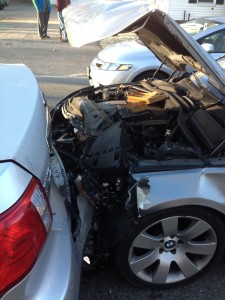
You’re stopped at a traffic light in South Portland, a stop sign in Portland or highway exit ramp in Falmouth, when suddenly – WHAM! a vehicle hits you from behind. You’ve been rear-ended. What should you do next?

In Maine, You’re Not Considered at Fault if You’re Rear-Ended

Every Maine driver is expected to operate their vehicle under control. That means being able to avoid an obstacle in the road ahead. If you’re following the rules of the road and stopped in traffic, waiting to make a turn, or just stopped, drivers behind you should be able to stop, go around you safely, or pay the consequences, regardless of road conditions. If it’s snowy or icy or rainy, they should allow extra time and distance, and be extra cautious.

Make Sure Everyone’s OK

First things first. Check on people before property. Is everyone in your vehicle OK? If it’s safe to get out of your vehicle, check on occupants of other vehicles involved. If there’s even the slightest injury (a bump, bruise – anything), call 911.

Check for Vehicle Damage

If it’s safe, get out of your vehicle and check the damage to all vehicles. Leave the vehicles where they are unless it’s completely unsafe. If you see ANY damage at all – no matter how minor it looks – we recommend that you…
accident

CALL 911

Technically, Maine police  only respond to accidents on public roads with bodily injury or combined property damage over $1,000. We recommend calling 911 even if you think there’s less than that, for 3 reasons:

  • It takes nothing to cause $1,000 damage to a vehicle. Even a bumpers cost more than that, with all the technology modern bumpers contain (airbag sensors, rear cameras, etc.). Also, modern bumpers are designed to be part of “crumple zones”. What may look like a cracked bumper often masks greater damage underneath. Police (and drivers) are notorious for underestimating the cost of damages.
  • The police will get the proper information. You’re stressed. Even if you trade information with the other driver, you’re likely to forget something that will be important to the insurance company.
  • Stories can change. People are much less likely to change a story they told the police at the scene – a story that’s now part of a written report. In our Portland area insurance agency, we hear it often: injuries “appear” in days after the accident; someone who admitted fault at the scene later says it was YOUR fault; insurance information is revealed to be incorrect or fabricated. Having the police take the report makes these situations less likely.

While You Wait for the Police, Get the Other Party’s Information

Whether or not you take our advice to call 911, at least get the other driver’s:

  • Name, address, and phone number
  • Driver’s license number (make sure the addresses match the one they gave you)
  • License plate number, and year, make & model of their vehicle (their registration will have this info).

This is important! Very often, the police gather this info but will not give this information to you at the scene. Instead, they give you a “report number”, and tell you the insurance company can call for that info. The problem is that those reports can take days or weeks to be available. Meanwhile, you want to get your car fixed.

Tip: Take pictures of these documents with your cell phone.

Report Your Accident to Insurance

In the case of a not-at-fault accident, call your agent, not your insurance company (you did buy from an agent, not one of those 800 numbers, didn’t you?) If you’re a client of ours, report your claim to Noyes Hall & Allen.

Report Your Claim to Noyes Hall & Allen


Armed with the proper information about the other driver and their insurance, we can do what your insurance company cannot do:

  • Help you verify that their insurance is valid;
  • Start the claim with that company.
  • Advise you whether to file a claim on your own policy, depending upon your circumstances.

Who Pays to Fix Your Vehicle?

If the at-fault party has valid insurance, their policy should pay these costs:

  • Repair your vehicle;
  • Rent a comparable replacement vehicle while yours is unable to be driven;
  • Medical expenses for anyone in your vehicle (some companies will make you collect from your own Medical Payments coverage first, and reimburse your insurance company).

Not everyone has valid insurance. Just because the other driver has an insurance card in their glove box, that doesn’t mean that policy is in force. Even though it’s state law to have liability insurance, 5% of Maine drivers don’t. If the driver happens to be from out of state, that percentage might be as high as 25% (Mississippi). In that case, you’ll want to know what to do if you’re hit by somebody without insurance. 

Should You Use Your Own Insurance?

Here’s why it’s better to have the at-fault party’s insurance pay for your damages.

  • The claim stays off your insurance policy;
  • You don’t have to pay the collision deductible;
  • There’s no dollar or time limit for rental reimbursement.

Some insurance companies accept fault more quickly than others. Some situations are more cut-and-dry. The insurer is entitled to conduct their own investigation before accepting responsibility. Meanwhile, you may decide to put a claim under your own policy, pay the deductible, and move on.

If your insurer recovers the damages from the at-fault party’s insurer, they will reimburse the deductible to you, and wipe it off your insurance record. If they cannot collect, the accident will show as an “at fault” accident on your record, and you may pay higher rates in the future.

Each accident is different, and so is each person. Your independent insurance agent can provide personal advice and advocate for you. If you have questions about Portland Maine area auto insurance, or Maine commercial vehicle insurance, contact a Noyes Hall & Allen agent at 207-799-5541.


Ron Blumenthal Retires, Innova Insurance Clients Can Rely on Noyes Hall & Allen


Ron Blumenthal, the founder of Innova Insurance Services in Scarborough Maine, retired October 31. Ron sold Innova Insurance to Noyes Hall & Allen Insurance in December, 2012. Ron had a close relationship with Noyes & Chapman for many years, which continued when Noyes & Chapman became Noyes Hall & Allen. Ron continued to work from the Noyes Hall & Allen office at 170 Ocean Street, South Portland Maine until his retirement.

Tina Countryman, who worked with Ron at Innova, remains at Noyes Hall & Allen, and continues to serve clients.

If you were a client of Ron Blumenthal at Innova Insurance, your insurance transferred seamlessly to Noyes Hall & Allen. Contact a Noyes Hall & Allen agent at 207-799-5541.

How to Thaw Frozen Pipes


In Maine winters, water pipes and other plumbing fixtures can freeze, causing water damage and inconvenience.

frozen pipe
photo credit: http://www.yakimawa.gov/

Our Greater Portland, Maine insurance agency fielded calls from clients this week due to the extreme cold weather. They wanted to know if Maine homeowners insurance covers damage from frozen pipes.

We also heard from owners of investment property, wondering whether their Maine landlord insurance covers this kind of damage.

In general, the plumber’s repair bill is not covered by these policies, but the water damage caused by frozen or burst pipes is.

Sometimes, clients call us when they discover the pipes are frozen, wondering what to do next. If you’re in that situation, here are some immediate tips:

How to Tell if Your Pipes are Frozen

  • When fully open, your faucet only trickles water, then stops completely.
  • You hear banging noises from inside walls or crawl spaces.
  • You see water staining on a ceiling or wall.

How to Thaw Frozen Pipes

We recommend calling a plumber. However, if you want to attempt to fix the situation yourself, follow these steps:

  1. Leave the faucet that is not working open (hot and cold).
  2. Turn off the main water supply.
  3. Locate the frozen pipe by opening other fixtures closer to the main water supply. The frozen section will be between the last working fixture and the first non-working one.
  4. The frozen section will probably be near a crawl space or outside wall.
  5. Feel the pipe, looking for a section that is very cold. There may even be frost or ice on the outside of the pipe.
  6. Warm the frozen section GENTLY, using a hair dryer. 
  7. NEVER use a flame or torch. Heating the pipe too suddenly can weaken it and cause it to burst.
  8. Work from the open fixture back to the frozen area. This keeps steam from being trapped by ice, which can burst the pipe.
  9. You should notice water trickling from the open fixture as the ice melts.
  10. Once all the ice is melted, close the fixture and open the main water supply.
  11. Make sure there are no leaks anywhere along the pipe.

How to Prevent Frozen Pipes

Before Cold Weather Hits:

  • Insulate exposed pipes located near exterior walls and crawl spaces with foil, then enclose with foam sleeve insulation.
  • Close and drain sillcocks (fixtures that pierce the sill of your home, usually a garden hose connection).
  • Learn where your main water shutoff is. Show everyone in your household how to close the valve.

During Extreme Cold Weather:

  • Open faucets (both hot and cold) enough to keep a trickle of water going.
  • Open under-sink cabinets against outside walls to allow warm air into the plumbing underneath.
  • Keep your home thermostat to at least 55 degrees.

We hope you never suffer frozen pipes. If you do, we hope this information is helpful. If you live in the Portland Maine area and have questions about home insurance, insuring income property, or condominium  and apartment insurance, contact a Noyes Hall & Allen agent at 207-799-5541.