Insurance for Cyclists in Maine

If you know me, you know that I like to bike year-round. Not every day, but most. I’m not alone. Two of our current staff of 10 regularly bikes to work.
bike commuter insurance guys

We’re lucky to live and work in the Portland area. Maine is ranked #20 most bike-friendly state by the League of American Bicyclists. The Portland Maine Bicycle Commuting Facebook group has more than 650 members (including me).

As a bike commuting insurance agent, it’s about time I wrote to explain how common insurance policies can protect cyclists, and suggest the best insurance coverage for Maine cyclists. The good news: many cyclists already have the basic coverage; they may just need to adjust their policies to get the best protection.

Car Insurance for Bicycles?

Most cyclists are also drivers, so they have car insurance. They’re probably unaware that their auto policy protects them when they’re cycling.  One part, Uninsured Motorist Coverage, is especially critical when you’re riding your bike:

Uninsured Motorist coverage protects you against injury

  • caused by an accident that’s someone else’s fault
  • if that person had no insurance or insufficient insurance

UM coverage can pay:

  • hospital and medical care
  • prescriptions and therapy
  • lost wages
  • pain & suffering

How Uninsured Motorist Coverage Works

UM covers the difference between the limit you purchased and what the responsible party bought. An example: someone with Maine state minimum limits ($50,000 per person) hits you. Your medical bills, lost wages and pain & suffering total $100,000. Your UM policy will pay $50,000 if you purchased at least $100,000 of coverage.

Key Takeaways:

  • Buy as much UM coverage as you can. For most Maine auto policies that’s $500,000.
  • Some umbrella policies allow you to include UM up to an additional $1 million.
  • Even if you don’t own a car, you can buy a “named non-owner” policy, including UM coverage.

Home, Condo or Renters Insurance for Bicycles?

The most common Maine property insurance policies cover:

  • Your bike and accessories against 16 “named perils”, including theft and vehicle damage.
  • Injuries or Property damage you cause to others while cycling
  • Legal defense against lawsuits for injuries or property damage.

They do NOT cover:

  • Collisions or dumping
  • Road damage such as potholes
  • Falling off a vehicle rack, driving into the garage with the bike on the roof rack, etc.

Key Takeaways:

  • Buy “replacement cost” coverage to avoid depreciation.
  • Buy “open perils” (sometimes called HO-5) homeowners coverage. This greatly expands the 16 named perils described above.
  • Your deductible will apply. Keep the value of your bike in mind when you choose deductibles.
  • Some insurance companies allow you to “schedule” your bike, which provides better (“open perils”) coverage, often at no deductible.

Related Post: HO-5 vs. HO-3 Homeowners Policies. What’s the Difference?


BEWARE: E-Bike, Scooter, Moped Insurance is Tricky!

Scooters, mopeds and similar self-propelled vehicles are considered “motor vehicles” by insurance policies. They should be insured on an auto or motorcycle policy. Maine State Law requires proof of auto insurance to register them. The insurance isn’t very expensive.

E-bikes are unique. They’re not considered to be “motor vehicles” by most auto insurance. But they ARE defined as motor vehicles on most homeowners policies, and thus EXCLUDED. That means no property OR liability coverage for e-bikes.

A few specialty e-bike insurance programs exist. For now, we recommend that you buy coverage from them to protect yourself against liability, theft and more. If you do purchase special insurance for your e-bike, pay particular attention to your Uninsured Motorist coverage. As of 2019, Noyes Hall & Allen sells a product that can provide up to $500,000 liability and UM coverage for e-bike owners.


FMI: Electric Bikes and Insurance – from Bike Law Maine


If you’re a cyclist in Maine, and have questions about insuring yourself or your bike, call Noyes Hall & Allen at 207-799-5541. We understand cyclists and insurance. We’d be happy to help you protect yourself better. We offer a choice of Maine’s top insurance companies, and know how to advocate for our clients. We’re independent and committed to you.


Resources:

Maine’s data card from League of American Cyclists (.pdf)

Bicycle Coalition of Maine website

Portland Maine Bicycle Commuting Facebook Group

How to Compare Insurance Prices and Policies

There are many ways to compare auto, home, condo or renters insurance prices. Most people prefer to save time and work by getting several quotes at the same time.

Two common methods: contact a local independent agent; or get multiple quotes from an app or web site. Businesses that produce these quote sites are called “aggregators”.

Online Insurance Sites & Apps: easy to use, but…

Online insurance shopping sites and apps are usually well-designed, easy and convenient to use.

Most don’t sound anything like an insurance company. They’re often named after a food or an animal, for some reason. Or they sound like tech companies.

That’s because most are not insurance companies. They’re really lead generators. And you’re the product they sell. Although insurance aggregators promise quotes, they rarely present firm numbers. Instead, they sell your information to insurance agents and companies. It’s up to those agents to try to close the sale.

And they’re relentless.

My Insurance Shopping Nightmare

I tried getting quotes recently. I’d barely clicked “submit” when my phone started ringing. It didn’t stop for 2 days. My voice mail clearly says I’m an insurance agent. You’d think they would quickly figure out that I wasn’t going to buy from them. But they kept calling back. And the emails! I gave them credit for persistence even as I cursed their repeated interruptions.

Think that’s unusual? Google insurance quote scams.

Of course, not all insurance quote sites are the same. Some provide an estimated price at the end of your session. But most of those still need more information from you to produce a policy. That can change the price.

Independent Agents: good insurance takes time

Independent insurance agents also offer several insurance options at the same time. They are locally owned businesses. There are about 35,000 in the US.

Call or visit an IA and you’ll spend 10 minutes answering the questions they need to quote. Then, the agent compares rates and coverage and presents a recommendation.

Instead of just taking your order, good independent agents use their local market and insurance knowledge to recommend the right solution. It may take a bit more time than the aggregator’s app, but that can be a great investment if  it helps you avoid an expensive mistake.

Some independent agents are more aggressive than others. Some even buy leads from aggregators. A few (like us) offer online insurance quotes 24/7 on their website. Most don’t share your personal information with anyone else.

It’s smart to shop your insurance

Savvy consumers know to compare insurance prices. You can call several “one company stores”; give your information to an online aggregator; or choose a local independent agent that you trust. If you’re in Southern Maine, Noyes Hall & Allen Insurance might be the agent you trust. Find out. Call us at 207-799-5541, get insurance quotes online, or stop by our South Portland office. We’re independent and committed to you.

Commercial Insurance for Maine Business Start-Ups

Commercial insurance is requisite for any business in the modern world, including start-ups. In fact, new businesses or start-ups have the most to lose if things go south. Therefore, it’s vital to protect yourself in the best possible way – including getting commercial insurance. In Maine, this type of coverage is not mandated, but if you are serious about running a successful business, you need to get it.

Purchasing commercial insurance might be the difference between death and survival  for your start-up. If you are planning to open a new business in The Pine Tree State and need coverage, Noyes Hall & Allen Insurance in Portland, ME is the place to look. We offer the following commercial insurance coverage options for start-ups:

  • General Liability Insurance for Start-Ups. GL pays for losses arising from settlements, claims, or lawsuits that your start-up may face due to injuries or property damage caused to third parties.
  • Professional Liability Insurance. Many creative and tech startups would face disaster if sued for copyright infringement, programming error, printing mistakes and other gaffes. Professional liability insurance protects you and your reputation by defending you and paying damages you might owe.
  • Property Insurance for Start-Ups. This covers physical assets owned by your start-up. This includes your investments in inventory, structures, equipment and company vehicles (commercial auto insurance). Damages caused by wind and hail storms, fire, smoke, collision and vandalism fall under this category.
  • Flood Insurance.  Flood damage isn’t covered by business property insurance. That’s why you need flood insurance for your start-up. Remember that flooding can occur anywhere, anytime. It helps to be covered from the resultant losses.
  • Workers Compensation Insurance. In Maine, if you have employees, you’re required to provide workers comp insurance. Your employees are an essential part of your business. Ensure that they are taken care of in case of an accident that results in injury, disability, or missed work.

Other coverage options are available, but these are the most important. Commercial insurance is the best way to make sure that your business doesn’t go under after an unfortunate event. For more information on commercial insurance from Noyes Hall & Allen Insurance in Portland, ME, call us at 207-799-5541, or visit our website to get the answers you need.

Why Isn’t it Cheaper to Buy Higher Property Insurance Deductibles?

Recently, a very smart guy asked on Twitter:

“why does it cost $19 a year to reduce my deductible from $1,500 to $1,000, but I only save $25 a year to increase it from $1,500 to $5,000? Shouldn’t deductible affect premium linearly?”

A wise guy responded with the snark that insurance often inspires:


Insurance Can Seem Illogical

Insurance is a big budget item. It costs a lot to protect your home, condo, car and other stuff (we won’t even start on medical insurance).

Insurance seems even more expensive because most of us don’t have claims very often. The average person has 3 or 4 auto accidents in their driving lifetime, and a home insurance claim every 12 years.

Insurance Is Mostly Math – and Math is Logical

The key concept of insurance is that everyone pays a fixed amount each year to avoid paying a huge and uncertain amount if something terrible happens. The money paid by the many goes to the few who have losses.

The typical fire claim is about $45,000. Liability claims average about $22,000, and water damage $9,000. Any of those would be a financial catastrophe for many Americans. Better to pay a fraction of that each year in predicable installments.

Insurance rates aren’t random. Insurance companies submit their rate requests to state insurance departments for approval. Those requests are accompanied by data about loss payments and current projections produced by math nerds called actuaries. The math can be heavy, and the results hard to understand.

Why Aren’t Insurance Deductible Savings Greater?

You might think that increasing your deductible by $1,000 should save twice as much as a $500 increase. That’s because you’re thinking about yourself, and your experience. The insurance company thinks about everyone’s claims, not just yours.

Most Claims are Small

While the average insurance claim is big, most claims are small. For every $100,000 fire claim, there are dozens of $1,500 ones. Think about it: every larger claim exceeds a smaller deductible, but not every claim reaches the larger one.

Insurance Deductible Example

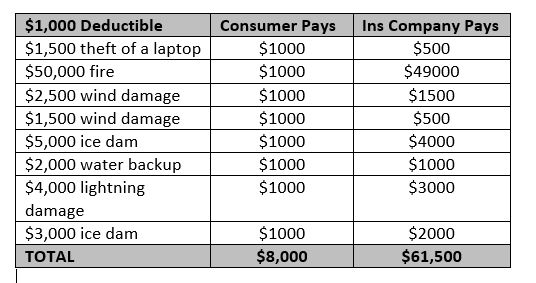
Here’s an example of 3 deductible scenarios using 8 typical claims:

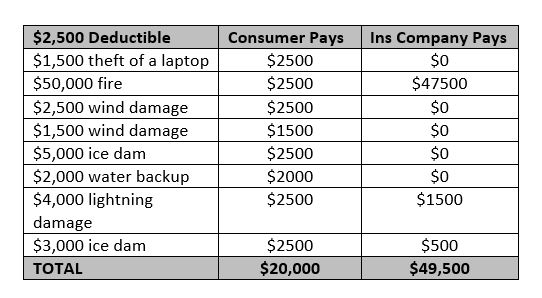
What happens when the deductibles increase to $2,500?

The insurance company sees that they pay 24% more on policies with $1,000 deductibles compared to $2,500 deductibles, so they offer a corresponding discount in their rates.

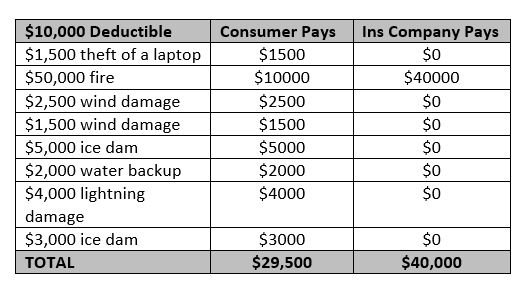
What if the deductibles were $10,000 instead of $2,500?

An individual or business owner might look at those figures and say “I’m taking a lot more risk with a jumbo deductible, so I should get a big discount”.

But the insurance company pays only 19% less, despite the $10,000 deductibles vs. $2500. The insurance company’s risk of claims payments isn’t linear, and so neither are the deductible savings. That’s why you don’t save as much when you buy a much larger deductible.

Logical, no?

Need Insurance Deductible Advice?

Do you live or own a business in Southern Maine? Have questions about your personal or business insurance?  Contact a Noyes Hall & Allen Insurance agent in South Portland at 207-799-5541. We offer a choice of several of Maine’s top insurance companies. We can help you choose the most cost-effective property insurance deductible. We’re independent and committed to you.

2017 Auto Insurance Winners & Losers – and Why it May Not Matter

The National Association of Insurance Commissioners (NAIC) released its annual market share report last week. It ranks US insurance companies by total sales. Some household names grew substantially. Other familiar brands lost big. Should Maine insurance consumers care? Should it affect your buying decision?

US Auto Insurance – a $230 Billion Industry

There’s plenty of competition for your insurance dollars. That’s why GEICO spends more than $1 billion a year on advertising, more than any other auto insurer. Was their big spending worth it? GEICO grew by more than $2 billion in premium last year. That’s more than twice the industry’s 2.5% growth in 2017.

Which Car Insurers Won and Lost in 2017?

Besides GEICO, Progressive grew by more than $1 billion in auto premium. USAA, Auto-owners and AAA rounded out the top 5. Allstate was the biggest loser. They shed almost $1 billion in auto insurance sales. Nationwide and Farmers weren’t far behind (ahead?). State Farm and Hartford rounded out the bottom 5, each losing almost $400 million of auto insurance premium.

Does it Matter Who Won?

Yes, and no. Growing companies can invest in new systems and even more advertising. Shrinking ones must cut costs. They might lay off claims adjusters or close offices to reduce expenses.

The winners and losers in the NAIC report have one thing in common. They’re all large insurers that write business countrywide. But many Maine consumers prefer to insure with smaller, regional insurers. Companies like Concord Group, Hanover and MMG Insurance have big market shares in Maine. New England insurers like these offer local claims and underwriting. They sell through local agents who provide advice and advocacy to their clients. They fly beneath the NAIC’s national radar.


Related: GEICO vs. Agent or Broker – Insurance Buying Tips


When Too Much Growth is Bad

Growth is good. But if an insurer grows too fast, bad things can happen:

  • Bad Service – an insurance company adding lots of new customers usually hires lots of sales people. If they don’t increase their claims and service staff by the same percentage, customer service can deteriorate. That can mean slower claim settlements, longer telephone hold times and inexperienced agents to give you advice.
  • Rate Increases – There are 2 easy ways to sell more insurance in the short run: sell it cheaper than the next guy; or relax standards to let more business in. Then it catches up. Pretty soon, they realize they haven’t charged enough premium to pay claims and expenses. They have to increase everyone’s rates to pay claims.

Is the Best Insurance Company One You’ve Never Heard Of? 

In Maine, many dependable, financially sound insurance companies don’t advertise. They have competitive rates. Their premiums don’t rise and fall dramatically. They settle claims fast and fairly using local adjusters.

How do you find these insurance companies? Contact a local independent agent like Noyes Hall & Allen in South Portland. We offer a choice from several top insurers and help you find the best fit and value. Want to get insurance quotes yourself? Get up to 5 Maine auto insurance quotes in 10 minutes from our web site. If you live outside southern Maine, look in your area for an independent agent like us. We’re independent and committed to you.

Home Insurance and Swimming Pools: What You Need to Know

Spring is almost here, and as the ground begins to thaw, you may be thinking about having an in-ground pool or above-ground pool built in your backyard. If you are planning on having a pool installed, it can affect your homeowner’s insurance policy. Here at Noyes Hall & Allen Insurance, serving the greater Portland, ME area, we want you to know how and why pools affect your homeowner’s insurance policy. Here is what you need to know.

When to Notify Your Home Insurance

Many people prefer to talk to their home insurance company before they sign a contract to have a pool built. This allows them to budget for  any increases to their policy, and learn if the company requires any safety features. You aren’t obligated to let your home insurance company know about the pool until it is fully constructed.

Why You Need to Notify Your Home Insurance

There are many reasons why you need to notify your home insurance about your new pool. A new pool increases the value of your property and may create issues that home insurance would need to cover. It can be a safety hazard for visitors and neighbors. As such, your home insurance company may need to adjust your policy.

What Changes Need to Be Made to Your Home Insurance

The insurance company may require certain changes to your policy. Regardless, you may want to increase your liability insurance coverage, or add a personal umbrella policy. This helps to protect you in case someone injures themselves or drowns in your pool.

If you are looking to have a pool installed in the greater Portland, ME area, you may be looking to change your homeowner’s insurance policy too. When you are in the market for a new policy, contact a Noyes Hall & Allen Insurance agent. Call us at 207-799-5541, or compare Maine home insurance quotes online today. We represent several home insurance companies so we can help you find the best value. We’re independent and committed to you.

4 Insurance Secrets Top-Selling Realtors Don’t Share


Top real estate agents know secret hacks can make the difference between making a sale and losing one. Present a personal letter from the buyer to the seller with the offer. Quality staging and photography sell houses. An early conversation with sellers can help avoid cold feet later.

Knowing about home insurance can drive sales, too. That’s why the top-earning realtors learn these insurance secrets and use them to sell more homes.

“There’s a Lid for Every Pot”

Almost every home is insurable. There are different types of lenders, right? Same with insurance companies. No single insurer will cover every home. Some prefer to insure luxury homes. Others like mobile homes. Some don’t insure homes on the ocean. Others do. Your client who buys a “fixer-upper” may use the specialty market until their project’s done, but coverage IS available for almost any home you sell.

A Good Buyer Can Insure a Difficult Home

Knob & tube wiring. An old roof. Electrical fuses. An unfinished deck. These are a few of insurance companies’ unfavorite things. You’ve heard about that “blacklist”. Buyers can’t insure homes with these issues. There’s some truth in that. But insurance companies are more flexible than you think.

Insurers underwrite people AND properties. A solid buyer with a credible plan to quickly fix property issues can still find good coverage at a great price. Need 30 days to get the work done? Insurance companies may allow it if an insurance agent they trust represents the client.

Insurance is More than a Binder

A lot happens between contract and closing. It’s easy for realtors and buyers to see “proof of insurance” as something to check off the list. Find a good price. Get your binder. Move on.

Not so fast.

What happens AFTER the closing? Will the price go up? Will the company cancel the policy after inspection? Will there be enough insurance to rebuild after a fire? Does their insurance dovetail with their condo association master policy? Will they have the right coverage to repair storm damage?  Recommend the wrong agent, and your referrals can dry up.

Speed is important. But insurance is more than a binder.

Your Insurance Referral Partner Makes a Difference

Which insurance agent do you refer your buyers to? Do they:

  • Offer a choice from many insurance companies?
  • Respond to you, your buyer and the lenders?
  • Thoroughly review the property and recommend the right coverage?
  • Advocate for your buyer to the insurance companies?
  • Adapt to changes between contract and closing?
  • Promise to be there for your buyer AFTER the closing?

Looking for a referral partner who knows the insurance market? One who works for your buyer as hard as you do, and owns and manages their own local independent business? One where your buyers can get quotes on their own from 5 insurance companies in 10 minutes? Contact Noyes Hall & Allen Insurance in South Portland. Since 1933, we’ve been independent and committed to you.


Insurance for Your Coastal Maine Home


You’ve found your dream home on the coast of Maine. Congratulations! Now you want to protect your investment. And, if you have a mortgage, your lender requires insurance.

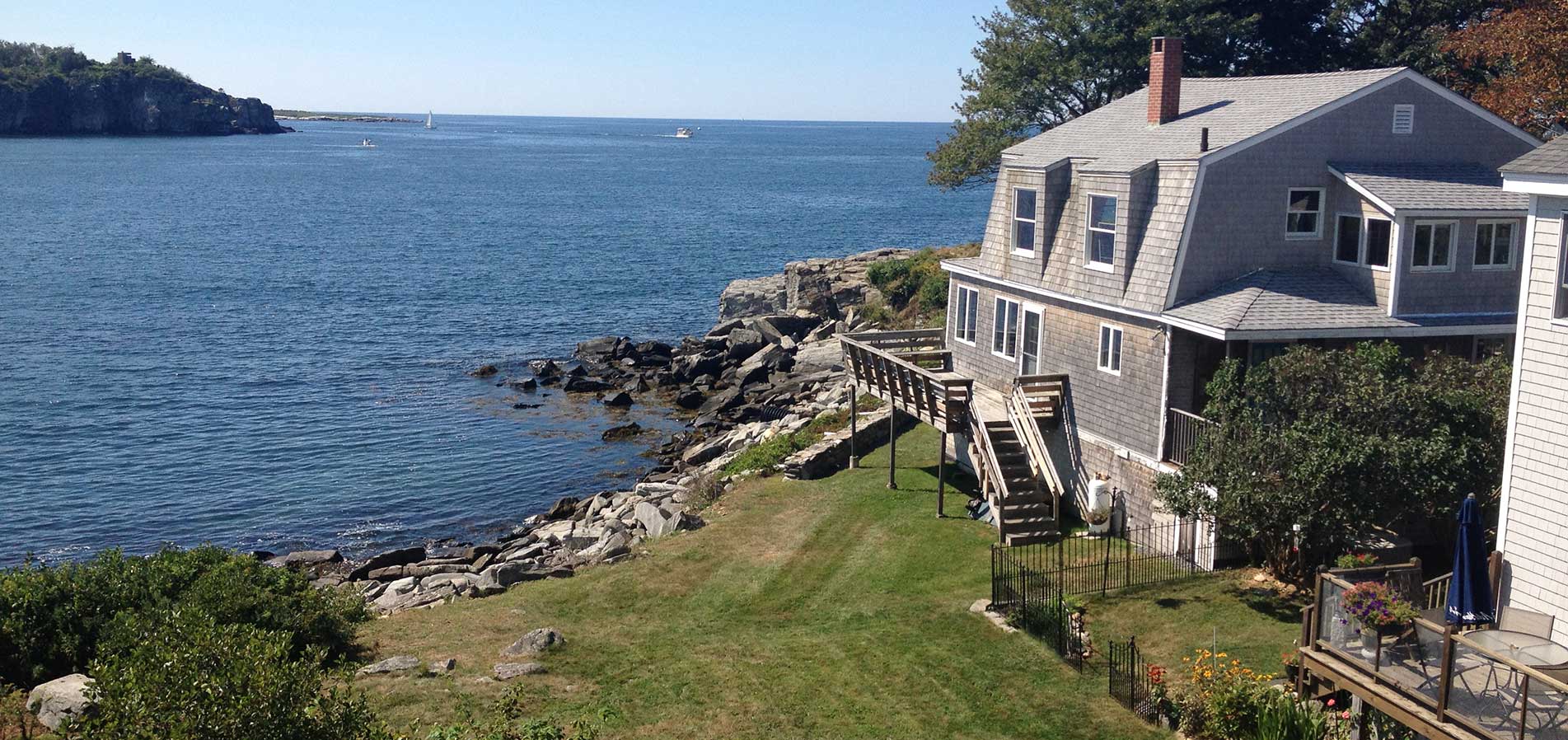
photo of a waterfront homeMany U.S. insurers restrict coverage for homes and properties near the ocean. They aren’t concerned about storm surge or water damage. Homeowners policies don’t cover flood or surface water. Wind is the issue. Homeowners, condo and renters insurance policies DO cover wind damage. That’s what insurance companies worry about.

The coast of Maine gets few hurricanes or tropical storms. But we still get nasty windstorms. Not as much as warmer states, but often enough. In the past 6 months, southern Maine has had 3 storms with damaging coastal winds. Properties closest to the coast are more susceptible. The same scenic view that drew you to your neighborhood exposes your home to wind. There’s no barrier to break up winds that come off the ocean. Buildings, trees and hills disperse winds farther inland.

Can You Find Insurance on Maine Oceanfront Property? 

The good news is that insurance is readily available. Your policy may have a special wind deductible, and you may pay more than your inland neighbors. But you also paid more for your property because of its beautiful location. Higher taxes, too. It’s a lifestyle choice.

How Close to the Coast is an Insurance Problem?

Insurance company underwriting varies. Some insurers will insure any home that’s more than 1000 feet (about 0.2 miles) from the ocean. Others draw the line at 1500 feet. Some apply special wind deductibles for any home within a mile of the coast. Others don’t.

Is this your primary home or a vacation home? Insurers are more eager if they have a chance to write your auto, boat or other insurance.

Is this an island property? Even if your home is more than 1000 feet from the coast, you may have few options available. A knowledgeable local agent can help you find your options.

How To Compare Insurance Quotes for Maine Oceanfront Property

The easiest way to survey the market is to contact an independent insurance agent like Noyes Hall & Allen in South Portland. Unlike State Farm, Allstate, GEICO, Progressive or USAA, we offer a choice of insurance companies. We know Greater Portland and the Casco Bay area. We know which insurance companies will insure coastal properties. We can check the market for the best value combination of price and coverage.

If your home is over 1000 feet from the ocean, get homeowners insurance quotes 24/7 from our website. If it’s closer than that, best to call a Noyes Hall & Allen Insurance agent in South Portland at 207-799-5541. We’re independent and committed to you.


What About Flood Insurance in Maine?

Flood damage isn’t covered by home insurance. The National Flood Insurance Program (NFIP) is a government program insuring against the peril of flood and surface water. Buy it where you buy your home insurance. Every insurance agent can sells it, and the rates are the same wherever you buy it.


How to Keep the Funds in Your Fundraising Event


You created a fabulous signature event for your non-profit. The stakes are high. Your budget – maybe your job – depends on its success. But you’ve done your homework. The board is jazzed. Volunteers, donors and the venue are ready. Publicity and social media are on point. RSVPs and reservations are rolling in.

Now all you need is good luck. Here’s how to stack the odds in your favor.

Your Programs Depend on the Event’s Revenue. Protect It

Insure the weather.

Does the forecast keep you up at night for weeks before your event? Believe it or not, you can insure the weather. A special insurance policy can reimburse you for lost revenue caused by stormy weather.

How does weather insurance work? Pick the amount of income you want to protect, and a “trigger”. For example, if it snows more than 6” at the event site, your insurance pays the amount on your policy.  It might cost a few points of revenue, but it’s better than a big loss if the weather makes everyone stay home.

Hire Out the Risky Stuff

Your non-profit is probably not in the business of tending bar, supervising a road race or shucking oysters. Do yourself a favor: hire a professional. One with their own insurance.

Don’t take on a lot of risk for a little savings. If something goes wrong, those savings are soon forgotten. But the injury or damage you caused to others – and to your reputation – could last a long time.

Protect Donations

Do you collect and store auction prizes and other donations before your big event? Don’t let a broken pipe, fire or theft erase the good they were intended to do. Add them to your insurance policy – and remove them after the event.  It doesn’t cost much, and can save a lot.

While we’re at it, make sure you have “money and securities” coverage and “employee dishonesty” coverage. Make sure your organization keeps the funds you worked hard to raise.

Love Your Volunteers

Your organization would be lost without them. You appreciate the heck out of them. Do you treat them that way? Would you leave them out to dry if they got in trouble from working your event? Does your insurance protect them against lawsuits for injury or damage they cause while volunteering? If not, fix that. Now.

What about board members? Committed directors are hard to find. Does your non-profit have Directors & Officers Liability coverage? Those with considerable assets are more likely to serve if they have protection from lawsuit. Don’t you owe that to them?


Talk to your insurance agent about your event. Explore the coverage we listed above. See what fits your budget. Better to explain to your board that you investigated insurance and chose not to buy it than that you never thought of it.

Noyes Hall & Allen helps Greater Portland non-profits manage their risk within their budget. That allows them to stay true to their mission and avoid financial catastrophe. If you’d like to talk to a Noyes Hall & Allen Insurance agent, call 207-799-5541. We’re independent and committed to you.

Should You Buy Special Boat Insurance?


Does Homeowners Insurance Cover Boats?

Homeowners policies cover very few boats for liability, and almost none for theft or damage. You can add liability coverage for an extra charge, but you’ll need a boat policy for more property coverage.

Boat Property Coverage on a Homeowners Policy

Most Maine homeowners, condo and renters insurance policies limit watercraft coverage to $1,500. Windstorm and hail damage is only covered if your boat is indoors. Theft is only covered if it’s at your home. Basically, anything bigger than a canoe needs a separate boat policy.

Boat Liability Coverage on a Homeowners Policy

Only sailboats less than 26 feet and power boats with less than a 25 hp motor are covered on most Maine homeowners policies. Anything larger than that, you need to buy either a boat policy or an endorsement to your homeowners, condo or renters insurance.

Why Don’t Homeowners Policies Cover More Boats?

Insurance companies try to include coverage that most people need. That’s why small outbuildings and garages are usually automatically covered. To keep premiums lower, they don’t include coverage for property that the majority of home owners don’t have. So, boats, firearms, jewelry and silver require special coverage, at an additional charge.

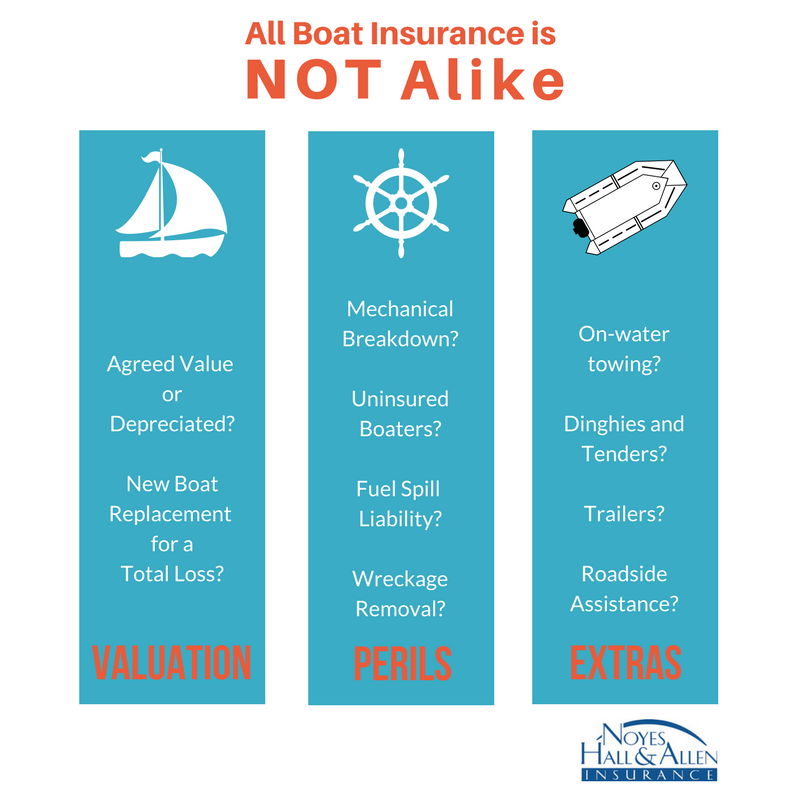
All Boat Insurance is NOT Alike

When buying boat insurance, pay attention to the details. Coverage varies a lot! Some insurers value your boat like a car (book value), while others will replace your 3 year old boat with a brand new model. Some will cover catastrophic motor failure, others will say “bummer”. Some will pay to haul your boat from the bottom after a through hull fitting fails. Others will write a check for the boat and walk away.  Choose the insurance you’re most comfortable with.

infographic of common boat insurance gaps


Where to Buy Maine Boat Insurance

Contact your local insurance agent and ask them about these coverages. They should have a policy that fits your needs and your budget. If you live in Southern Maine and are looking for a boat insurance agent, call Noyes Hall & Allen in South Portland at 207-799-5541, or leave your contact info here and we’ll reach out. We insure watercraft from aluminum runabouts to antique wooden sailboats. We offer a choice from many insurance companies. We’re independent and committed to you.


Related Post: How Much Does Maine Boat Insurance Cost?