6 Best Practices to Deal With Maine’s Rising Property Insurance Rates

Most insurance companies doing business in Maine would like to forget 2011. Maine narrowly escaped many of the disasters that plagued other Northeastern states (one Maine insurance executive tells of nervously, repeatedly “refreshing” the online map of Hurricane Irene’s storm track). Still, virtually every insurer was affected because they do business in those neighboring states.

Remember the terrible flooding in Vermont? Hurricane Irene in southern New England? The tornadoes in Central Massachusetts? Widespread power outages from falling snow-covered tree limbs? Insurance companies do. They paid all those claims.

Many people don’t know that insurance companies also buy insurance – called reinsurance – to protect themselves from financial disaster. Reinsurance spreads the cost of risk throughout the world, leveling loss experience. Reinsurance works: despite the recession and the heavy losses, insurance companies remain financially solvent and able to pay claims.

Unfortunately, 2011 set a world record for disasters . Losses were $105 billion, the highest number ever. About 1/3 of those losses, and 4 of the top 10 events, were in the US. That means that reinsurance companies are now increasing the rates that insurance companies pay for property reinsurance. Of course, that translates to higher homeowners and business property rates for you and me.  So, what can you do?

Map of major disasters in the US in 2011
click to enlarge

6 Ways to Help Offset Rising Property Insurance Costs

  1. Don’t overinsure. Your Maine business property insurance agent  or homeowners insurance agent can help you determine the insurable replacement cost of your property, so you can adjust your protection accordingly.
  2. Compare rates. There are 2 ways to do this: call around yourself; or consult a Trusted Choice independent insurance agent.  This kind of  insurance agent represents several insurance companies, and can compare prices and coverage for you.
  3. Get the discounts you deserve. Don’t pay too much by failing to get the business or  homeowners insurance discounts you’ve earned. Have you recently replaced your roof, electrical, heat or other system? Installed an alarm or a generator? All of these improvements may qualify for discounts. Talk to your agent, and ask if there are other discounts available.
  4. Combine and save. Most insurers give a discount when they insure both your property and vehicles. That goes for business or personal insurance. If you own coastal, seasonal or secondary property, some preferred insurance companies will accept you if they insure your primary home, too. This can rescue you from paying higher non-standard rates with another insurance company.
  5. Choose deductibles wisely. If you’ve owned your property for a long time, you may have more financial ability to repair small losses (it’s not a good idea to file multiple, small claims anyway). If so, ask your agent how much you could save by increasing your property deductible.
  6. Maintain your property. It should go without saying, but deferred maintenance leads to claims, and claims lead to higher premiums. Replace your roof or heating system before it causes a loss. Clear leaves from your gutters every fall to prevent ice dams. Regular paint and upkeep can prevent trouble later.
Maine property insurance rates are expected to rise for some time. In times like this, it makes even more sense to develop a relationship with a local agent. In the area of Portland Maine, insurance agents are plentiful. Find one whose professional advice you trust, and who represents many preferred insurance companies. If you have questions about your personal or business property insurance, contact our experienced agents at 207.799.5541.

Trusted Choice Insurance Agent Video Debuts in Portland, Maine

We’re enjoying this new Trusted Choice video, which highlights the advantage of using a local independent insurance agent. Not only will you get personalized advice from a local professional, but you have the option of choosing from among several insurance companies at once.

We are proud to be your Portland, Maine area Trusted Choice insurance agent. For answers to your insurance questions, contact Noyes Hall & Allen Insurance at 207.799.5541.

20120309-203728.jpg

When an Employee Layoff Goes Bad


Bill runs a café on the West Side.  Since a nearby hi-tech facility had a major layoff, lunch business has dropped 25%. In fact, Bill had to let Willie, one of his waiters go last week. Now, Bill’s wife Elaine stands in the kitchen with a concerned expression on her face and an official-looking letter in her hand. Willie hired an attorney and filed a lawsuit alleging wrongful termination and discrimination.

Elaine calls the café’s insurance agent. Good news! Bill & Elaine followed their agent’s recommendation by adding Employment Practices Liability Insurance (EPLI) to their portfolio of coverage last year. When the agent explained that the average cost of defending a groundless lawsuit is $20,000, they knew they couldn’t afford the risk. Their agent explained that the insurance company would respond on their behalf, hire a lawyer if necessary, and pay any damages if they are found liable. Bill and Elaine just avoided a huge expense  one that could have forced them to close their business.

Are you smart, like Bill and Elaine? Has your insurance agent recommended EPLI coverage to you? If not, you might consider:

5 Myths About Employment Practices Lawsuits

1. Employee Lawsuits Are Rare

Employment related lawsuits happen more than you think. Six in ten employers in the U.S. have faced an employment-related lawsuit in the past 5 years.

2. Only Large Employers Get Sued For Employment Practices

Nationwide, more than 40% of employment-related practices claims are brought against employers with fewer than 100 employees.

3. Employee Lawsuits Don’t Happen in Maine

Think again. The Maine Human Rights Commission or Maine Workers’ Compensation Board handle more than 800 employment-related practices complaints every year.

4. It’s Covered by Liability or Workers’ Comp Insurance

Unless you have specifically purchased EPLI coverage, the costs of defense or damages are NOT covered by standard Workers Comp, General Liability or Professional Liability insurance policies.

5. EPLI Insurance is Expensive

Depending upon the type of business you operate, Maine Employment-Related Practices Insurance costs as little as $30 per employee per year – or $0.58 per weekly payroll period.


What does EPLI Cover?

  • Legal Representation to defend you against claims from current, former or prospective employees, including:
    • discrimination (age, sex, disability, race, religion, etc.)
    • wrongful termination
    • sexual harassment or hostile work environment
  • Damages you’re legally obligated to pay.
  • Court costs and related expenses.
  • Some policies also offer counsel with an employment law professional to help you during the hiring employment and termination process.

If you have employees, your business is at risk. For answers to your Maine employment liability insurance questions or Maine workers compensation insurance questions, call Noyes Hall & Allen at 207-799-5541.


You Can’t Guarantee The Weather – But You CAN Insure It!

Many southern Maine jewelry store customers were hoping for snow on Christmas Day. Why? A local jeweler ran a well-advertised promotion promising free jewelry if it snowed on December 25. How can they afford to take that chance? We don’t know for sure, but we hope they consulted their local Maine insurance agent. While our agency had nothing to do with this promotion, we have helped clients reduce their risk by selling them weather insurance for special sales or events.

Can a Business Insure Against Bad Weather?

You bet! Let’s say your business plans an open house or a big one-day sale. You advertise heavily for 2 weeks before. You buy extra inventory, and add extra staff to take care of demand. But, a heavy snow storm keeps your potential customers at home, and you lose a lot of money. Or, you could buy a weather insurance policy to help recoup part of those costs, and cut your loss.

Can a Business Insure Against a Rainy Summer – or a Warm Winter?

What if your minor league baseball team suffers through a rainy summer? Or your tubing hill business encounters a warm, dry winter? Your organization might lose all sorts of same-day revenues: walk-up tickets; concessions; parking income, and more. A customized weather policy might pay a set amount if more than a certain number of game days have a specified amount of rain. A snow-area business could insure a mild winter in the same way, thereby stabilizing their income.

How Does Weather Insurance Work?

Like a good news article, weather insurance addresses the 4 W’s: What, When, Where and Who. As long as the event is measurable and the terms are specific, it can be insured. The price depends upon the terms. For example, if 6 inches of snow fall at a specific address in Portland, ME between 12:01 am and 11:50 pm on December 25 as measured by the National Weather Service, the insurer pays an agreed amount or percent of  a pre-determined period sales. Decrease the number of inches and you’ll pay more premium; shorten the sale period, you’ll pay less.

Fifteen Businesses That Might Buy Weather Insurance:

  • Florists and Nurseries – for big pre-season open house or important Spring and Fall weekends.
  • Candy Stores – The last few days before Valentines Day are key!
  • Golf courses – Insure against late snowstorms that can put a season on hold.
  • Baseball teams – Rainouts mean lost revenue.
  • Farmers’ Markets – Ever notice that it seems to rain EVERY Thursday?
  • Snowmobile dealers – Reduce the risk of overbuying inventory in a dry winter.
  • Ski resorts – It’s tough to make snow when in 40 degree weather. Even out budgeted revenue projections by insuring against warm weather.
  • Tour companies – It’s a short season already. One rainy month can cause disaster.
  • Car washes – Although I always seem to wash my car right BEFORE it rains, very few of us actually wash them WHILE it’s raining. A summer of rainy weekends means business lost forever.
  • Jewelers or Car Dealers – High-ticket items are perfect for attention-getting giveaway promotions.
  • Hotels & Motels – To level out income fluctuations when reservations are canceled due to weather.
  • Festivals and Events – They’re expensive to put on, and it’s often tough to have a successful “rain date”.
  • Beach parking lots
  • Film Production Companies

The possibilities are almost endless.

Where Can You Buy Business Weather Insurance?

Several online options offer “self-service” weather insurance. Being a Maine independent insurance agency, we recommend using the services of an agent or broker. It costs exactly the same.  A Maine  business insurance expert can help you determine your needs and work within your budget. They can also help you evaluate the market, to assure that the insurance company is reputable and financially secure. And, they can help you if you need to file a claim.

For more information about business weather insurance, contact Noyes Hall & Allen Insurance at 207-799-5541.

Pay As You Go Maine Workers Comp Insurance

Workers Comp – A Cash Flow Challenge for Your Business

Paying workers compensation insurance can be a cash flow challenge. In slower months, it’s hard to scrape cash together for that quarterly payment. It’s also hard to estimate a year ahead what your payroll will be. Over- or under-estimating payroll at the beginning of the policy year creates a big year-end audit adjustment. You either get a big bill, or a big refund of money you could have been using to run your operation all year.

Pay As You GoWorkers Comp Integrated with Payroll

Maine employers have a cash-flow friendly option for paying their Maine workers compensation insurance. MEMIC, Maine’s largest workers’ comp insurer offers “Comp-As-You-Go”. This workers comp billing integrates with virtually every payroll provider, including ADP, Paychex, Advantage, Bangor Payroll, and many more. It also works with Quickbooks software.

How Does Pay-As-You-Go Maine Workers Comp Insurance Work?

It’s simple to understand, and easy to start up. Pay-As-You-Go:

  • Integrates with payroll services or QuickBooks software. Just fill out a form with your payroll info.
  • Allows you to keep your current payroll process and frequency. Simply send a file after every payroll run (weekly, bi-weekly, bi-monthly or monthly).
  • Requires no premium deposit.
  • Payments are automatically withdrawn by MEMIC.
  • You can leave the pay-as-you-go plan any time during the policy term.
  • Avoids year-end audit bills and surprises.
To learn more about payroll service integration with Maine workers comp insurance, contact Noyes Hall & Allen Insurance at 207-799-5541.

Am I Covered if a Falling Satellite Hits My House or Car?

I realize I’m out of the loop, but was I the only one surprised to wake this morning to news that a huge piece of space junk is headed straight for Earth?

As usual, my friend Sabine was way ahead of me. She had already tweeted this insurance question (and blog post idea!):


The Answer to Every Insurance Question is: “It Depends”.

If you have  Maine homeowners insurance, business property insurance, or anything other than the most basic kind of property policy, you’re covered for damage caused by “aircraft, including self-propelled missiles and spacecraft”.

If you have  Maine car insurance, commercial vehicle insurance, or contractors’ equipment coverage, and have included “other than collision coverage”, you’re covered against hurtling space junk. If you bought “liability only” coverage, you’re taking your chances.

Fortunately, your chances of getting hit are infinitessimally low. Probably.

If you live in Southern Maine, and  have questions about your insurance, our Portland area insurance agency can help. Call Noyes Hall & Allen Insurance at 207-799-5541. Or, post on our wall by finding Noyes Hall & Allen on Facebook or tweet us @NHAIns on Twitter.


Three Ways to Keep Epsilon Spammers from Phishing Your Money!

On March 30, Epsilon, one of the world’s largest email marketing companies, reported a breach of their system.  Epsilon sends more than 40 billion emails a year to consumers who register on one of their clients’ websites or who give their email addresses while shopping.

Have You Received an Email Like This One?

“Dear Valued Customer,
On March 30th, we were informed by Epsilon, a company we use to send emails to our customers, that files containing the email addresses of some [company name here] customers were accessed without authorization.”

Millions of people have. As of April 18, 2011, clients of more than 100 companies and brands have been hit, including big names like GlaxoSmithKline, Shell, Radio Shack, PacSun, Capital One, JPMorgan Chase, J. Jill, Sears, Crate & Barrel, Walgreens and Abercrombie & Fitch.

According to Epsilon, the breach was limited to email addresses or customer names only; they report that no other personal identifiable information was stolen. Despite that, many security experts are concerned about the implications.

Having even a person’s email address and their spending habits or favorite brands may make it easier to craft a sophisticated phishing attack. For example, you could get an email that appears to be from a company you know and trust, asking you to log in and provide  information that may seem harmless. This nefarious technique is called “spear-phishing”.

Prevent Phishing Attacks

1.  Stay on guard – especially now. Be extra careful about where you click and what information you enter on a website.

2.  Scrutinize emails from any company. Look for typos and strange URLs. Look at the email address of the sender. Don’t click on those links!

3.  Call the company in question if you get a suspicious email,. No company should be asking you for sensitive information by email.

If you have questions about identity theft in Maine, contact Noyes Hall & Allen, a Maine Trusted Choice independent insurance agent. If you’re looking for Maine data breach business insurance, our business insurance specialists can help.  Call us at 207-799-5541.

Thanks to Steve Anderson for sharing these tips, which we’re sharing with his permission.

Avoiding Commercial Building Roof Collapse: Removing Snow from a Roof

This week’s snow has accumulated on the roofs of Maine homes and commercial buildings, increasing the risk of collapse and ice dams. The snow has finally stopped in Portland, Maine – at least temporarily. It’s a good time to evaluate whether you need to remove snow from a roof.

High-Risk Areas – Heavy Snow Load Can Cause Roof Collapse

  • Large, flat roofs, or those with less than a 30º slope.
  • Heavily insulated roofs
  • Roofs with previous structural damage or stress.
  • Shaded areas, where snow can freeze into ice.

Evaluate Your Commercial Roof Before Snow Load is Critical

  • Create a plot plan to identify skylights, drains and scuppers, wiring and equipment.
  • Monitor rooftop conditions throughout the winter to identify ice buildup, blocked drains and snow drifts.
  • Use experienced, knowledgeable employees or (preferably) hire an outside contractor.
  • Hire only experienced contractors who can provide proof of business general liability insurance.

Warning Signs of Roof Collapse

  • Improper operation of doors or windows.
  • Deflection of ceiling finishes or exposed beams.
  • Roof leaks
  • Sprinklers moved from their normal positions
  • If you notice these, contact a structural engineer or your local building inspector.

How to Safely Remove Snow from a Roof

  • Do not remove snow all the way down to the roof membrane.
  • Use plastic shovels – never metal – on your roof.
  • Fill a plastic tarp with snow and release over the side of the building, carefully watching where snow is landing to avoid people and property.
  • If using a snow blower, adjust to prevent rotating components from contacting the roof surface.

Most Maine business property insurance policies cover roof collapse. Policies do not typically cover maintenance such as snow removal or other prudent loss prevention measures. If you have questions about commercial building insurance, contact the experienced Maine insurance agents at Noyes Hall & Allen Insurance at 207-799-5541.

We’re proud to be agents of Acadia Insurance, MMG Insurance and Hanover Insurance,  whose loss control tips which were used in this blog post.

What Should I Do When Someone Hit My Parked Car in Maine?


This week alone, two of my friends’ parked cars have been hit by someone else. One in Portland Maine. The other in Westbrook, Maine. A responsible person would leave their contact information for the poor victim, but that doesn’t always happen. If you can’t identify who hit your car, you have little recourse but to use your own insurance.  However, if you can identify the other party, this information may be helpful.

Flickr photo by gillicious

What To Do If Someone Hits Your Car in Maine

  • If it’s safe to do so, get the person’s name, address, phone number and insurance company information – BEFORE the police arrive!
  • Call the police if the total damage (both vehicles) appears to be more than $1,000. If there’s visible damage – even minor – it’s probably more than $1,000.
  • Give your statement to the police. Don’t admit any fault to the other driver, or argue about whose fault the accident was.
  • Report the accident to your Maine auto insurance agent.

Should I Use My Insurance or Theirs?

If the accident was clearly the other driver’s fault (e.g. you were legally parked), try their insurance first.  Using their insurance avoids having to pay your collision deductible, allows you to keep your Maine car insurance discounts, and contains no daily limit on rental coverage. Of course, if  you’re a victim of a hit-and-run accident, you have no choice but to use your own insurance. Your own local insurance agent can help you start the process.

Use their insurance if:

  • You got their insurance information at the scene, or can quickly get the Maine police report (many police reports aren’t available for several days).
  • Their insurance company accepts responsibility quickly (within 24 hours after you contact them).
  • You did not buy collision coverage on your own policy.

The Other Company Isn’t Responding After the Accident

The other insurance company must confirm liability before they accept responsibility to fix your car. They do this in one of three ways:

  • Their customer admits to them that they were clearly at fault (e.g. hit your parked car, rear-ended you at a stop light).
  • The police report says the other driver was at fault (police reports may not be available for several days).
  • After their own investigation, the insurance company determines that their customer was at fault.

If it’s taking too long for the insurance company to accept responsibility, you may choose to make a claim on your own policy.  You’ll have to pay your collision deductible, but at least you’ll get your car fixed, and get on with your life.

Will I Get My Deductible Back if My Insurance Company Collects from the Other Insurance Company?

Yes. if they collect from the other insurance company (a process called “subrogation”), your Maine insurance company will reimburse your deductible, and wipe the accident off your record.

Who Will Help Me Deal With The Other Insurance Company?

That depends on where you bought your insurance.  If you bought your car insurance or Maine commercial vehicle insurance from an independent local Maine insurance agent like Noyes Hall & Allen, they can help you report that claim to the other company. Your claim against the other insurance company should not affect your insurance company or your policy.

If you bought your Maine car insurance online, you’re probably on your own. One more reason to buy insurance from a local agency instead of a computer or 800 number. 

Of course, if you have no insurance at all on your vehicle, you’re really on your own.


Is Your Maine Home in a Flood Zone?

Recent changes proposed by FEMA have put flood insurance in Portland, Maine on the minds many. Every property is in a flood zone, and has the possibility of suffering flood damage. Some properties are in “special hazard zones”, which means that they are more susceptible to flood. Lenders usually require borrowers to buy flood insurance as a requirement of getting a mortgage for these properties.

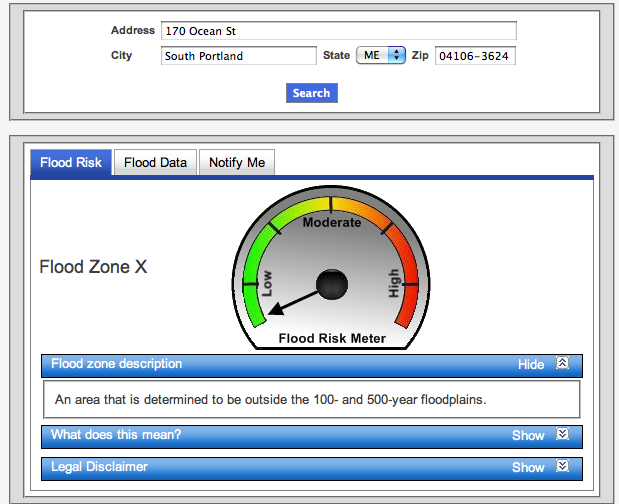
If you’re wondering what flood zone your property is in, there is a free tool available at FreeFlood.net. It’s a database of the flood zones of 100 million U.S. addresses. Simply enter your address, and instantly see flood zone information, along with a “flood meter” reading.

Graphical Flood Zone Meter

If you’re buying a home or commercial property in Maine , this is a great tool to help you budget your property insurance costs. For more information about homeowners insurance, business insurance, or flood insurance, contact Noyes Hall & Allen Insurance at 207-799-5541.

Special thanks to Steve Anderson of Steve Anderson’s TechTips for introducing us to this useful tool. Steve’s blog is a great educational resource for Maine insurance agents like us.